The children have been an absolute delight to us. Babies and toddlers are startled when they see us and cling tightly to their mothers. I'm sure they think they've seen a ghost. Four to six year olds come running, waving and singing a little song that they've learned at school: "Nasaala! Good Morning, how are you? We are fine, thank you." Then they smile broadly, so pleased with themselves.
Saturday, 30 July 2011


Teacher Workshops: July 25-26 and 27-28
 Teachers in the Wa West Workshop
Friday, July 28
Our first workshop was held for Wa West teachers in the Wa West District Assembly Hall. We had invited 80 Untrained Teachers in Diploma in Basic Education (UTTDBE), and were surprised when 94 arrived. Fortunately the room was large and had electricity, so we taped a large white bed sheet to the wall and used both an LCD projector and an overhead projector. Despite slowing down our speech the teachers still found our accent difficult to understand, so the visual support was helpful. We were able to move the heavy wooden chairs, some with an attached arm into circles for group work, but it was quite the obstacle course to manoeuvre around.
Our second workshop for the Wa East District was held at the Loggu Junior High School. 40 UTTDBE were invited to this workshop, but 50 showed up. The pupils were finished classes for the year, so we split into two groups and used two classrooms. This three classroom JH school has no electricity, or water. Pupils carry bowls of water to school to fill a large blue garbage pail size container that has a spout close to the bottom to press for a drink. The classrooms have wooden shutters on glassless windows that tend to blow shut in the breeze. Floors are bare concrete, and overhead there are exposed wooden rafters covered by an aluminum roof. The heavy wooden desks and attached benches are cumbersome to move, uncomfortable to sit in and many were in need of repair. Rearranging the classroom for group work was tricky. The concrete wall blackboard was cracked, pitted and a light grey colour, which made it difficult to see the printing. We didn't quite master the knack of writing without continually breaking the soft chalk. Blackboards are blackened every few weeks by grinding the inside of D-cell batteries, mixing the black powder with water and then using the mixture to paint the blackboard. Flies were a constant distraction in the classroom and although we didn't actually see any mosquitoes we did get bitten despite our insect repellent.
Our focus for both workshops was the same. We reviewed the English Syllabus (Program of Studies), and worked on planning: term, weekly forecast and lesson notes. We began both workshops by giving teachers yellow post-it notes, and had them write their challenges. Teachers posted the notes around the room according to their grade level, and then walked around and read them. We later compiled the notes and ended the Workshop on the second day by reviewing, discussing and brainstorming possible solutions. The number one challenge in both Districts was the lack of resources: Syllabuses (Program of Studies) for subjects taught; teacher guides; student text books; library books; Science, Math and ICT materials and equipment; pens and exercise books; and desks and chairs. Following was class size (one teacher had 91 pupils); attendance; lack of teacher in-servicing and support; and a shortage of teachers. The challenges may seem overwhelming, but the tone was positive. These teachers genuinely care about their students and want to do the best they can.
As I helped the teachers plan I found it ironic that they were given the task of teaching subjects with absolutely no resources. ICT is a good example. ICT is a mandated subject with a syllabus, yet schools do not have electricity, computers, or the internet. The general aims in the Primary 1-6 syllabus state that the pupil will: acquire basic ICT literacy, communicate effectively using ICT tools, develop interest in and acquire skills in the use of the internet, and acquire basic mouse and keyboarding skills. The general aims in the JH syllabus are: acquire basic ICT literacy, develop interest and use ICT in learning other subjects, use the internet effectively for information, follow basic ethics in the use of ICT, and acquire keyboarding skills.
I enjoyed talking to the Loggu JH Headmaster (Principal) about the challenges he faces. His school was in dire need of resources. He told me that his current Office was actually a storeroom, and he had moved it there so that his teachers would have a place to mark their tests. I was surprised to learn that he was not able to hire teachers personally, as the government posts teachers to schools in Ghana. Unlike another school I visited, his school allowed pupils to take their textbooks home to study from and to use to complete homework.
The four days were rewarding for us, and although our workshop was just a drop in a very large bucket we are hopeful that it will make a difference.
 Wa East Workshop. Here you can see part of the classroom during our whole group final discussion activity on Teaching Challenges .
 Junior High teachers at the Loggu Workshop are crowded around my laptop screen reading a syllabus. Some schools do not have a copy of the subject specific syllabus, as they are distributed in limited quantities with the expectation that schools will photocopy them. Photocopying is expensive. The syllabuses for every subject are posted on the Ghana Ministry of Education website, so I was able to download them on my laptop for the teachers to read. None of the teachers in either workshop had a computer.
We had a few babies in both workshops.
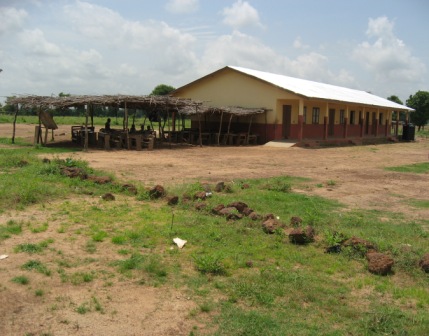
 The Loggu JH school. The washsrooms are located in the blue and white building just behind the school.
 The Principal, a teacher and a student are looking over his final test results and grades in the small Teachers' Room (Staffroom).
 The Principal of Loggu JH School moved his Office into the storeroom, so that his teachers could have an area to mark their tests.
Meeting Sponsored Children
 Maria and Tiffany each sponsored a child during their time in Ghana and had the opportunity to meet their child. What an amazing experience!
Termite Homes

Huge red coloured termite mounds stand out against the lush green landscape alongside the roads. We've seen some over 6 feet high which we were told can take termites 15-20 years to build. The hole in this termite hill was made by villagers, who shovelled termites out to feed to their chickens.
Monday, 25 July 2011
Making Charcoal

July 24
As we drove down the road to Lassia for Mass , we passed many women carrying large containers of charcoal on their heads. It was market day in Wa and they were walking to Wa to sell their charcoal. Charcoal is used for cooking and is made by burning wood in a huge pile of soil. This buried pile of burning wood is in our Centre and has been burning for the past four days.
 On our way home we passed the Vieri Primary School. The three room school was constructed by Chalice. It is now overcapacity, so some classes are held outside as you can see in this picture. Look carefully and you will see the standing wooden blackboard, which was purchased by Chalice.
A close-up view of the outdoor classroom and standing wooden blackboard.
Saturday, 23 July 2011
Seamstress Shops

Seamstress shops with hand powered sewing machines are very common here. This is the shop where I had a blouse and skirt sewn, using the fabric Maxwell chose. We visited a smock shop in Wa and the three tailors were using electric sewing machines to sew men's smocks.
Mole National Park

Josephine, Philip, Maria and our guide Adam in front of a group of African Elephants.
July 21-22
Half of our three hour drive to the Mole National Park was on a bumpy, red clay road, bordered by some of the loveliest villages we have seen so far. Many of the mud homes had designs of lines and dots etched into their walls. The majority of the remote villages that we passed had power lines and bore holes (wells), yet the tall cell phone towers beside them still looked out of place in the tranquil setting. Generally when you approach a village on the road there are handmade speed bumps to slow vehicles down. This road had speed bumps, huge pot holes, ruts, and the occasional cow and goat sunning themselves on the road. We finally arrived at the park and checked into the Mole Motel.
Mole is the largest national park in Ghana. The savannah woodland park is home to 93 mammalian species, 33 reptiles, nine amphibians and 300 bird species. We went on two safaris and were fortunate to see kobs, bush bucks, ververt monkeys, water bucks, baboons, warthogs, crocodiles, striped ground squirrels, patas monkeys, a nile momltor lizard, a mongoos, a saddle bill stock and elephants. Did you know that elephants only have two enemies- people and soldier ants?
A number of baboons frequent the Motel hoping to steal food from people eating at the outdoor restaurant. We were told that they only steal food from women as they are afraid of men. As we walked from our room to the restaurant we saw a baboon open the door of an unoccupied dormitory and go into it. He came out empty-handed, and ran off to try his luck by the pool.

These two African elephants have just come out of the water. All African elephants are black. The reddish brown elephants in the picture below have covered themselves with soil to protect their skin from insects and the heat.


The baby baboon is sitting on its mother in this group of baboons

A bush buck
Subscribe to:
Posts (Atom)